

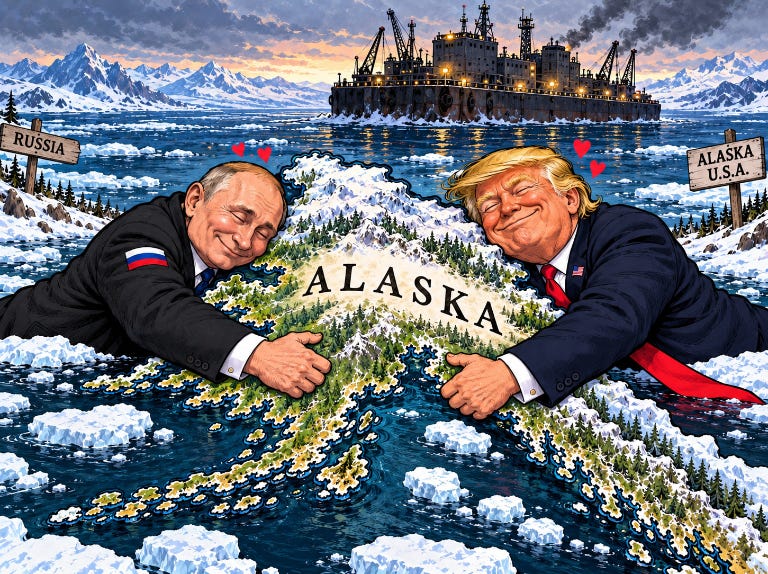
In the past week, two major national stories have been about Alaska. The first story involves the Trump administration filing a preemptive lawsuit to contest the results of the November 3rd election if the incumbent Republican senator, Dan Sullivan, loses his reelection bid. (The “part two” of that involves reporting about how a second candidate with the same name may have ended up on the ballot.) The second story involves top American executives resigning from a project to produce Alaskan liquified natural gas (LNG) for export after finding out it was being “secretly” financed by a sanctioned Russian entity (both the FT and NYT broke aspects of the story).
These stories have garnered separate outrage on social media and in television commentary — but what if, fundamentally, they are the same story? The same story of a president unfettered by institutional and legal constraints, sure. But more importantly, the same story of a president who feels both that he owes Putin and that Putin owes him — and time is running out to deliver.
The clock ticks down, and amidst all the other chaos, we aren’t paying enough attention to the many ways President Trump specifically seeks to anchor Russian interests to American ones before he leaves office. But the Alaska story is a good place to start.
* * * * *
The two Alaska stories come together on a landscape replete with deliverables from Trump to Moscow. Offered in the context of his supposed desire to achieve “peace” in the war between Russia and Ukraine, these actions have been so grotesquely misaligned to represent Russian interests that they have elicited condemnation across the full spectrum of American media and from bipartisan voices in Congress.
A short summary of the president’s handouts to Putin in the last few weeks includes:
A deal to import Russian diesel into the US — domestically, little more than a pre-election stunt (the quantity is minuscule and will do nothing to change prices for Americans), but internationally, a signal that deals can be done with Moscow that will provide Russia more capital to fund their war
Blocking the implementation of a package of sanctions, which was named for late-Senator Lindsey Graham and passed with broad bipartisan support, meant to severely limit Russia’s ability to pay for its war
Discussions about how to ease more sanctions on Russia, including on the Russian Direct Investment Fund, a tool of Russian influence operations whose director now basically lives in Florida buttering up Trump “envoys” Kushner and Witkoff. Neither is an employee of the US government, but nonetheless they remain in charge of negotiating with Moscow, nominally about the “peace” deal but more about business deals, including a deal to buy $20 billion of global Lukoil assets (which the Russian energy giant is forced to sell due to sanctions) that the USG has helped steer toward a consortium that will benefit the Trump, Kushner, and Witkoff families directly — and yes, that capital can also help pay for the war
Disruptions and slowdowns in Starlink or Starshield communications services, which Ukraine relies on to mount attacks against Russian targets and to defend against Russian attacks on Ukrainian civilians; these suspensions seem to be linked to pressure on Ukraine to stop targeting Russian petroleum facilities
Disruption in the sharing of US intelligence used by Ukraine to defend against Russian airstrikes on Ukrainian cities and to identify targets in Russia
Delays in the provision of PATRIOT interceptors which had been purchased for Ukrainian air defenses
Pushing our European allies to buy more Russian gas — which again provides funding to Moscow for the war, and also erodes progress Europe has made on decoupling from the Russian gas supply that is direct tool of Russian geopolitical influence and interference
Machinations to hold new talks with China and Russia on the future of Ukraine, without Ukraine (Will Bunch described it as “like Yalta but with three Stalins” and this phrase now has permanent residency in my brain)
This list, which does not include pro-Russian statements from Trump or the embarrassing “humanitarian” groveling before Putin by Trump’s envoy, makes the American president chief salesman for Russian petroleum, and it hamstrings Ukrainian efforts to defend their nation from Russia’s genocidal attacks on their people. It can be viewed only as coercion against Ukraine and gestures of alliance to Moscow.
* * * * *
Into this rat-tat-tat of stories about Trump’s aid for Putin enters news from Alaska, where a closely-contested race could determine if Republicans keep control of the Senate after the midterms.
But first, a little context on Alaska.
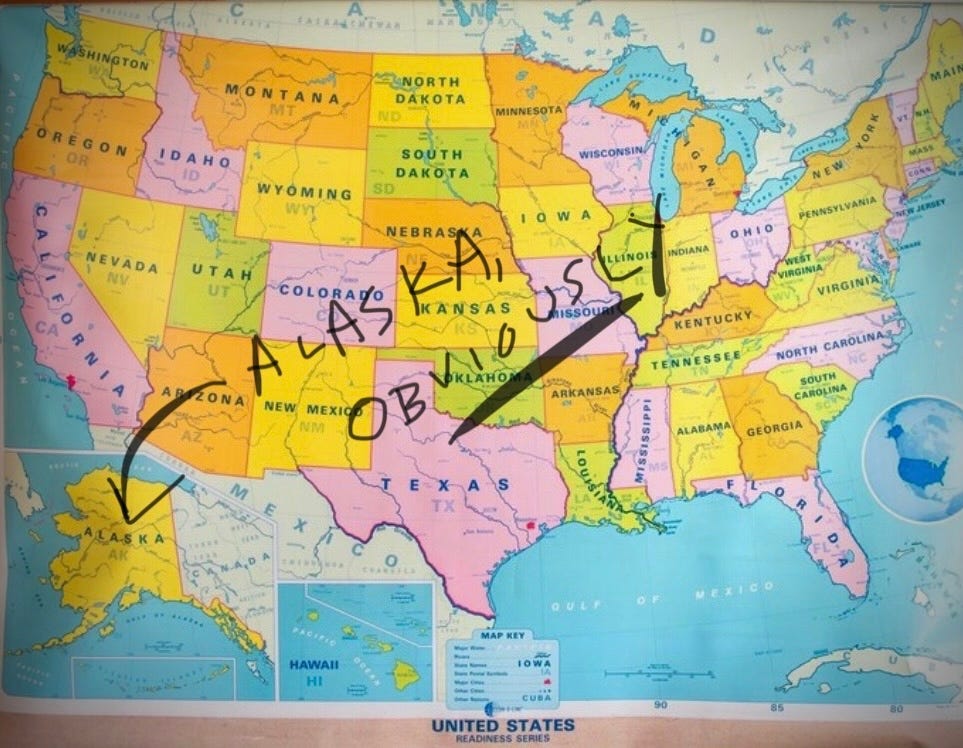
For most Americans, the state of Alaska is as it appears on the basic American grade school map — an impossibly large disjointed landmass floating somewhere to the side of (or often underneath) the continental United States (CONUS), its location vaguely understood as “north” just as it’s floating sister Hawaii is understood to be “somewhere in the Pacific.” We memorize their state capitals along with all the others (Juneau and Honolulu — neither accessible from the CONUS by road), but the states remain exotic, less bound by the rules and order (and shipping costs) that hem in the contiguous states — which is exactly how the residents of both states generally prefer it to be (except for the cost of shipping, presumably).
But the acquisition of both states was critical to the formation of the modern concept of America as a global superpower, and this is entirely about their actual positions on the globe, reaching high up into the Arctic and far into the sweeping, unknowable Pacific — which we’ve always regarded with far more suspicion than the Atlantic, if we’re honest. The Atlantic anchors so many of our American origin stories and historical memories and ongoing alliances. The Pacific is vast, and everything across it is far from us and far from each other. Enemy attack in the Pacific brought us into WWII, and the ensuing Cold War kept that specter of “across the Pacific” alive. Decades later we do have powerful Asian allies, hard-won but as essential and trusted as any NATO nation.
But in the vastness, the specter remains.
“The Pacific” is a different place — a different potential theater of conflict and opportunity — and Hawaii and Alaska comprise the core of the American Pacific nation. Alaska is also our Arctic one. They are separated from the CONUS not only on maps, but also in mindset and reality.
Sparsely populated Alaska has a distinct character that Alaskans are quick to tout — in particular that it is bloody cold there for a lot of the year, and that people live in far greater isolation and remoteness, with many communities accessible only by boat or air during certain times of the year. “Alaskans have to help each other out to survive” is an oft-referenced idea that reflects the unique aspects of life in the state, where they say people have to work hard and generally be much more attuned to the natural world around them. Alaska also has a higher percentage of indigenous people as citizens than any other state, which contributes to how decisions are made about development projects versus the preservation of the environment and traditional ways of life. The government remains a major employer, and the quest for job creation in other sectors that will bring investment to the state is a top priority. This often requires state or federal investments in infrastructure to offset the costs of remoteness — but this makes sense since about 60 percent of the state is federal land, 20-30 percent belongs to the state, and another ten or so belongs to Alaska Native Corporations, leaving less than one percent of land in private hands.
Alaska is seriously massive — 16 percent of total US territory (and about a third of total federally-owned land, for those keeping track). Alaska has two neighbors — Russia and Canada — neither of them (yet) a US state. Alaska is up there on its own. The overall belief is that non-Alaskans can’t possibly get it — and this is manifests politically as an intense state sovereignty.
And these facts of orientation and geography matter deeply as we look at recent headlines from Alaska (alas, I don’t mean the headlines for Fat Bear Week).
* * * * *
First up, the election.
Trump has pulled out all the stops to aid Senator Sullivan in his re-election bid. This has been a bit two-edged, however.
On September 30, Trump hosted Sullivan, Alaska’s sole congressman Nick Begich, Alaska Governor Mike Dunleavy, and others in the Oval Office to announce that South Korea would invest $54 billion in the Alaska LNG project, which envisions the construction of an 800-mile pipeline to transport natural gas from Alaska’s North Slope (that’s the part way up at the top by the Arctic Ocean) all the way across Alaska to a liquefaction and export terminal in the south. This is meant to help Alaska exploit its significant gas reserves and to export LNG to Asian markets (talks have targeted allies Japan, South Korea, and Taiwan) — a need made more urgent by both Russian sanctions and shipping disruptions in the Strait of Hormuz.
This announcement surprised South Korea. They say the project, still in early planning stages, is under review as a potential component of a more general commitment to invest significantly in American energy projects, but that no decision has been made. Pressed further on the issue, President Trump insisted he had not “jumped the gun” on his announcement. He then threatened to double tariffs against our Asian ally if they didn’t comply with the investment.
On October 6, the administration announced it would use $150 million from the Defense Procurement Act to help fund improvements to Alaska’s electrical grid. Vice President Vance flew to Alaska for a campaign rally and a visit to Elmendorf Air Base at the same time.
A week later, on October 13, Trump himself flew all the way to Alaska to hold a campaign rally. By then, the Korea investment fizzle had gained attention locally. But election season is election season, and on October 14, President Trump posted that *Taiwan* had now agreed to invest $4 billion in the Alaska LNG project, and would also buy 30 percent of the project output for 20 years. Taiwan quickly said the project, as it is still in early phases, is under review but no commitments had been made.
Opinion pages in Alaskan media are onto this gambit, and more broadly have noted that all the president’s announcements about foreign investors and federal involvement have done nothing to clarify or accelerate the project. Leaving aside the foreign export angle, the project is vitally important for Alaskans, who, despite living in a state frequently described as a giant untapped gas bag, can face natural gas shortages themselves during the long winter heating season. The project could also provide jobs for a huge number of Alaskans (almost as many as the entire current mining sector, or more than one percent of the population), as well as revenue for the state, which would own a 25 percent stake in the project.
On October 26, for good measure, the Department of Transportation announced $105 million for six port development projects in Alaska.
All of the administrative resources the White House has directed to Alaska did little to move the polls, which remain very close. So, time to get out of the bag of hammers. On October 23, the Department of Justice filed a lawsuit to block the results of the Senate race if Dan Sullivan doesn’t win. Trump said he ordered DOJ to file the case. The case seems poorly argued, but focuses on a second Dan Sullivan who appears on the rank choice ballot and tries to make the case that if OG Dan Sullivan loses because of votes for the other Dan Sullivan, the Democratic victory shouldn’t count.
Even Alaska’s Republican-led government wants nothing to do with the DOJ lawsuit. Alaska’s Supreme Court already ruled on this issue, which allowed non-OG Sullivan’s name to appear on the ballot while clearly listing OG Dan Sullivan as the incumbent. The DOJ lawsuit is, at the very least, an extraordinary violation of state sovereignty to oversee elections. But it’s a thumb on the scale that can become a fist of a narrative if the balance of the Senate looks iffy.
The fist of narrative became more likely given another component of the story, which was written in the NYT after the lawsuit was filed — insider allegations that a Democratic campaign was involved in recruiting the other Dan Sullivan to appear on the ballot as an effort to confuse some voters.
I’m not going to say much more about that, but would direct you toward any number of stories from this election cycle about Republican efforts to fund rogue far-left and other candidates to help ensure their candidates have weaker opponents on the November ballots. As long as the Supreme Court says that money is speech and must be free to ruin the democratic process, the bleak landscape is what it is, which is a hell of judicial making. Our elections will be shaped by shenanigans and not policy, anger and not ideas, and Americans will continue to live worse and worse for it. Alas, the Supreme Court is not accountable to us voters. And I’m sure the DOJ, which has whipped up some subpoenas for a criminal probe into the allegations in the NYT reporting, will be issuing subpoenas to all the other dirty tricksters too (any day now…). The state of Alaska has announced its own investigation — likely to forestall more DOJ meddling, but that didn’t work since DOJ now operates primarily on presidential pestering. If it wasn’t this case, it would have been something — DOJ is creating preemptive outrage hooks in every state with close elections.
Why do all this? Because Trump really needs Sullivan to win — and not just because of the balance of the Senate, but because he needs a guy that he thinks owes him on the hook in Alaska.
* * * * *
But the second story is where things get weird.
We’ve already heard a lot about the big LNG project — Alaska LNG — but there’s a second LNG project under development. While Alaska LNG is a major state initiative to develop Alaskan gas production and move it via the new pipeline, the other project, Polar LNG, has been a bit of a sideshow. It’s the second Dan Sullivan of Alaskan gas projects, if you will.
Before going into any details, let me explain why I said “secretly” financed by Russia in the opener.
From the very beginning, this project was an effort by a sanctioned Russian gas company to gain access to Alaska via a friend of the president’s son — the same friend who found some other random Russian with funding from a different Russian gas company to pay for the festivities at that president’s son’s Caribbean island wedding, replete with a posse of more random Russians to stand around in the background of party photos. The bloke footing the bar bill also has a foundation in Russia that, amongst other things, helps brainwash children stolen from Ukraine. (Do read the ProPublica report — it was excellent reporting that the son didn’t even bother refuting, though he now says he has “reimbursed” the Russian funding of his wedding party).
What you’ll notice there is, as the president likes to say, RUSSIA RUSSIA RUSSIA. I will give the execs who quit the Polar LNG project credit for doing the right thing when there could have been serious legal consequences not to. But, people, it is not our first day here, and when some Russians show up and say they have a 54000-ton floating concrete LNG facility based on sketchy technology that they would like to move to Alaska’s Arctic coast — but don’t worry! it’s a Gulf nation front company paying! and it will absolutely never be used to spy on or launch attacks upon American soil! — I mean, ok, enjoy whatever villa you bought with your salary, but don’t give us the Home Alone face about how you didn’t know this was a Russian project or whose interests you were working for. Credit, for real — but they’re just going to pay the next guy more so he is even happier with his villa and less interested in the crossed Ts and dotted Is in “sanctions.”
But let’s jump back to the origin point and start coloring all the Russias in the lines.
Since the early days after Trump’s first electoral victory — as all across Russia, Kremlin-aligned pod bros and more public spooks cheered their great victory in America — a long list of sanctioned Russian companies and oligarchs have been looking for ways to get off of the sanctions list. One of those companies was Novatek, Russia’s second largest gas giant after Gazprom. Via an intermediary, Novatek approached one of the B villains of the first Trump term, then-associate finance chair of the Republican National Committee Elliot Broidy.
Now, if you remember Broidy’s name at all — so many B villains, so little time — it’s probably either because he had to resign from his RNC gig for paying off a Playmate to hide his affair with her, or because he would later plead guilty to charges of being an unregistered foreign agent. He was pardoned by Trump on the last day of his first term before he went to jail. But — don’t worry! — as all the B villains are absolutely unflushable turds, Broidy is still alive and well, his new business venture having recently won a $106 million contract from the Department of Justice to use AI to help the Bureau of Prisons transcribe and monitor prison phone calls. That’s right, a guy who pleaded guilty to illegally representing a foreign interest and who has undefined relationships to Russian oligarchs now runs a database that the company says “represents the world’s largest concentration of criminally-minded activity – all on recorded lines, all legally accessible.” What could possibly go wrong?
Anyway, back in 2017, Novatek approached Broidy about their sanctions problem, and Broidy offered them a complex plan to get out of their sanctions. The whole idea was foiled by Senator John McCain, who understood Trump’s proclivities toward Russia and said if he tried to lift the Russian sanctions, Congress would cement them in law. Fast-forward to 2024, and Novatek is back for Trump term 2 looking for a way to solve their worsening problems in America.
August 2025 marks the Trump-Putin “summit” in Alaska. A week later, Putin himself talks to the Russian press about the amazing business deals discussed with Trump, including the potential of Russian gas giant Novatek’s “unique technologies” to work in LNG in Alaska.
Enter the sketchy friend of the sketchy son of the President, one Gentry Beach. Beach is the head of something called America First Global, a company looking to turn Trump family ties into large cash payments from a range of unsavory global sources. He was a groomsman at Don Jr’s first wedding, and, as mentioned above, the procurer of Russian financing for the second. (I won’t waste more time on the laundry list of scandals, shady deals, and court battles he has been involved in, but this WSJ profile is a good place to start if you are interested. If you google him further, you will find the profile is exceedingly kind in making him seem rich and foolish, as opposed to what he more likely is all about.)
In February 2026, Beach gave an interview to the NYT about Novatek and its “unique technologies” for producing LNG in Alaska. In the interview, he explained that he started speaking directly with sanctioned Novatek’s CEO just after the Alaska summit via meetings in Dubai and Europe. The project they discussed envisioned using a large, moveable Russian gas liquefaction plant to produce LNG for export from Alaska’s Arctic coast, including via a fleet of icebreakers. The gas plant is already under construction in Murmansk — the sister of a first floating liquefaction platform that has struggled to prove the concept that this type of facility can succeed in providing reliable LNG supplies from Arctic regions.
Beach was quick to say that the project, soon launched as the Polar LNG project, was complementary to the Alaska LNG pipeline project — smart market diversification as opposed to competition. Beach set up a separate entity for himself with “Polar” in the title but is not employed by Polar LNG (presumably, because he was insulating himself from it). Some corporate intermediary that would act as the pass-through for Russian funds was get up in the UAE. Sprinkled across all of this are former executives from Novatek, but wearing shiny new hats. Meanwhile, the new CEO of Polar LNG announced the project to bring Russian technology from a sanctioned Russian company to Alaskans without ever once mentioning the word “Russia.”
“Secret” Russian financing. I mean, come on. The whole thing is about the Russian company and giving Russia a foothold in a vitally important strategic industry in Alaska that is poised for massive investment — and Alaska is territory which, let us not forget, Russian commentators frequently argue Russia should take back. So yes, it does matter that the Russian financial connection has been established and isn’t just implied. But this was hardly a secret.
* * * * *
After the news “broke,” the Alaska congressional delegation was quick to denounce Polar LNG. Senator Lisa Murkowski, not up for election this year, released a statement saying she did not support projects that in turn support Russia’s war in Ukraine, and that Alaska didn’t need Russian technology on its North Slope. A spokesperson for Sullivan offered that “the only natural gas export project in Alaska Senator Sullivan has focused on is the Alaska LNG project, which is closer than it’s ever been,” and called Polar LNG “a distraction.”
But asked about the Polar news while voting in Florida, President Trump replied: “We want Russia and Ukraine to reach an agreement so that things can return to normal where we can do business with both sides.”
It’s also no secret that Trump, Kushner, and Witkoff have always been more focused on “doing business with Russia” than a just end to Russia’s war in Ukraine. Talks with Russia about LNG have always been on the menu. Alaska may want nothing to do with the Polar LNG project — but Trump and his envoys have discussed it with Putin, and then Trump took executive action to make pursuit of the deal possible.
This summer, there was a bit of a diplomatic spat between the US and Russia, as Russia’s forever-Foreign Minister Sergei Lavrov told officials that the Trump administration had broken the agreements made in Alaska and “appeared to be abandoning any claim to the role of an objective mediator and are instead pursuing a course of escalating sanctions pressure on Russia.” American officials were quick to say that there had been no formal agreement in Alaska.
But Putin’s message was delivered: we talked about business but you made promises on sanctions.
And now, many of those sanctions have been suspended.
Alaska doesn’t need the Polar LNG deal. But giving Russia that small foothold in Alaska’s future suits Russia — and Trump — just fine. After all, if the main Alaska LNG project advances, would anyone complain if there were coattails for the sideshow? As his presidency draws to a close, Trump gets more overt with his threats and bullying, and this would be an easy thing to elbow into someone’s gullet — perhaps a senator he wants to harangue about how he got him re-elected. The project would be an access point to the territory and an industry that Russia will know how to exploit.
* * * * *
A key aspect here remains the uniqueness of Alaska for America. The Arctic is a hot topic, and Alaskan representatives, especially Senator Sullivan, have used the shifting landscape of Arctic security challenges and economic opportunities to secure new resources for the state, including significant military build-up and an expanded Coast Guard presence to keep on eye on Russian and Chinese activities in the Arctic.
The Trump administration has given a lot of attention to this topic — but often, it is unhelpful attention, such as the two-year obsession with the US acquisition of Greenland (finally solved recently by, you know, expanding the terms of the current US basing agreement in Greenland like a grown-up, and without the need for threats of invasion against our allies), or threats to make Canada “the 51st state” — or else. (Sorry, Canada. So, so sorry.)
Canada is a major economic and practical partner for Alaska, and Trump administration policies to punish Canada for standing up to his bullying have left Alaska more isolated from its good neighbor, even as President Trump slavers west toward the bad neighbor.
For Russia, with its 15,000 miles of Arctic coastline along half the Arctic Ocean, the thawing Arctic has meant new opportunities for shipping routes and resource exploitation — aka, a new frontier for Russian economic development. As Russian aggression defines the Putin era, this has also meant significant investment in military infrastructure and hardware across Russia’s high north — to secure those resources and Russian ambitions.
It comes as no surprise then that Russia is investing more in its Arctic than all other Arctic nations combined. But it is investing more — a lot more — in Chukotka, which is only a few kilometers from Alaska across the Bering Strait. And when the CEO (and resident Floridian as chief Russian trumpworld negotiator) of the maybe-to-be-unsanctioned Russian Direct Investment Fund starts saying Russia is planning a rail tunnel under the Bering Strait to link Russia to Alaska, which he has invited Elon Musk to help construct — well, “no thank you” doesn’t quite cover it, certainly not while Russia relies on railways to move military materiel. Also, this may be a good time to remind Alaska to check if the Alaska Permanent Fund still holds hundreds of millions of dollars of investments in Russia. This is not a door to leave open.
Our European allies have gotten Russia’s message on the Arctic following a drumbeat of hybrid attacks and other aggression, and they have released a new strategy to focus more on the Arctic amongst themselves and with partner Canada — and to focus less on what America might bring unless we happen to become reliable again.
All this means American military build-up in Alaska is more important than ever. There is no Arctic nation more isolated right now than Alaska as the American Arctic. Alaska really may have to go it alone in ways they haven’t thought of since the 1980s. But all the military investment in the world means nothing if the American Commander in Chief is so enamored of Moscow that he has no idea what the threats to our nation really are.
* * * * *
Since 2016, President Trump and his backers — foreign and domestic — have done remarkable work creating the “Trump-Russia hoax” narrative, which has been aces for minimizing the highly unusual relationship the president has sought with the Kremlin and cultivated with all the minions Putin dispatches to entice cooperation. The lion’s share of this work was done by Trump’s first term Attorney General Bill Barr, who preemptively announced that the Mueller report found no evidence of “collusion” between the Trump campaign and the well-documented Russian efforts to influence the outcome of the 2016 US election (and every election thereafter). This statement was the first and only reporting most Americans absorbed about the Mueller investigation, and one which factually stands in stark contrast to the actual findings of the report, particularly in the later version released with less redaction (links to those reports here — but let us not also forget the five volumes of the bipartisan Senate Select Intelligence Committee report on Russian activities in the 2016 election, which remain available here).
The illusion of “no collusion” made discussing Russian aggression against the United States — its direct attack on the American public and on the ability of our free will to inform our democratic choices — seem out of bounds. This sentiment was enhanced by shady online armies — many subsequently linked to Russian intelligence and influence projects, yes — and by the propensity of President Trump to lose his marbles and lash out with vitriol and retribution against those still pressing the case that what Russia did was an attack on our nation.
Trump’s silence on this matter made him complicit after the fact even if he had not been before, and his constant entreaties to Moscow ever since just confirmed that he understands who it is he owes. He may think of it as who is “on his side,” a kind of kinship or mutual understanding — an envy of totalitarian power. But the origin of this feeling toward Putin is subconscious acknowledgement of the effectiveness of a standard Russian intelligence tactic: Russia pays in advance, and then you are already complicit if you aren’t willing to immediately bring light to the trap they laid for you.
A decade later, we know who Trump really is, and what he thinks of the American constitution and American democracy and the role of American power in the world. He remains a masterful propagandist, and when he says to look away — look away from 2016; look away from January 6th; look away from the soaring national debt that is symbolic of the concentration of power into fewer and fewer American hands; look away from the burgeoning wealth of himself, his family, and the families of his envoys and friends — most people are only too happy or cowed to oblige. Worse, they are too happy to parrot the narratives of doubt (we can’t be sure that…; but everybody does it…) and weakness (but what can anyone do about it…; everyone just wants to get on with it…) that allow him to continue on his endless pilgrimage to make America more like our adversaries than our own national legend.
Like many Americans, I am appalled by the base way that Trump and those closest to him view our national riches as some kind of swag buffet for a party they never should have been invited to, stuffing item after item into a bottomless tote, gorging themselves on our tax dollars and bribes for pardons and advancing the interests of foreign nations, wrecking historical sites for branded merch, pocketing strategic resources.
But far worse than the generational self-enrichment that will cement these thieves as a forever-part of our national political landscape — if we do not put them in jail — is that their self-dealing has helped anchor non-ally foreign interests into our economy, infrastructure, and security. And in some cases — like with Russia — it is clear that these efforts are quite purposeful.
Underneath the smash-and-grab, burn-it-down mindset of Trump’s final term in office is consistent work for the man Trump owes — the man Trump still expects so much from. And that man is Vladimir Putin.
Dan Sullivan (the Senator, not the panoply of other Dan Sullivans apparently populating Alaskan politics) has been a national leader in pushing for the US to develop an Arctic strategy and take the increasing threats and opportunities of the Arctic — presented by climate change and pressed by our adversaries — seriously. He’s even managed to take real steps forward for Alaska on national defense and other interests by embracing the yahoo-ism of this administration. But to help get him re-elected when Trump’s own surging unpopularity is an albatross around the neck of nearly every Republican incumbent, Trump announced raffle prize after raffle prize for Alaska, and even flew all the way there to wave his little hat. It’s a lot to deliver — and all around the edges of those promises is how deeply it matters that strategic American interests and territories are not comprised by Russia.
The strategic isolation of Alaska from its traditional partner and neighbor, Canada, coupled with the mishandling of potential partnerships with America’s Asian allies and the slowly opening door for the Kremlin as an alternative to either, is simply bad math for Alaska — and a bad omen for American efforts to be a real Pacific and Arctic nation. Alaska disproportionately matters to American power and American security in the 21st century, and it deserves far better than backdoor efforts to entrench the interests of America’s most aggressive adversary into its affairs.
Alaska wants nothing to do with Trump’s efforts to meddle in their state sovereignty and elections. Alaska — at least politically — wants nothing to do with Trump’s effort to give Russia access to their energy sector. But Trump wants it, and by forcing himself into one story, he thinks he can dictate the outcome of the other.
Much like the story of the 2016 election, it doesn’t matter if the Russian schemes achieve all their targets or not. The point is that the process corrupts and captures individuals along the way.
Trump keeps trying to find ways to anchor Russia into our economy, our security, our understanding of the world. Alaska itself is a strategic American asset. Compromising our Arctic platforms and high north development — forging Russia a place in Alaska’s future while forcing Alaska’s isolation from Canada — is a bad place to start.
I’ll close with a short excerpt from Senator Mitch McConnell’s op-ed about Trump’s pandering to Putin, which is fit warning to Alaska, as well:
Regardless of the midterm election results, Mr. Putin is America’s enemy. He is aligned with China, Iran and North Korea to divide the U.S. from our allies and undermine our global influence… Americans, including most Republicans, understand this. They sympathize with Ukraine’s defenders, its abducted children, its shivering elderly and persecuted Christians. They know America’s strategic interests are aligned with Kyiv’s. If the president means what he says about ending the conflict, he should look to the wisdom of the American people, not naive businessmen who seem to think diplomacy entails fawning over adversaries. Mr. Putin is many things, but he is no humanitarian. A Russian victory would have far worse consequences for our economic and national security and our global influence than temporarily high diesel prices.
Enough with the B villains and with White House schemes to leave a pillaged America exposed to adversarial powers in ways that become harder and harder to put right. The Alaska story exposes how much the Russia story is still the real story.
Trump may indeed feel that time is running down. Far better, then, to leave behind a weakened and defeated Russia than a resurgent one.
— MM