

President Trump has pushed the nation toward a fulcrum — a point where the entire definition of American power could unhinge, and after which there is greatly increased risk for the United States of America. The possibility takes shape in the inexorability generated by the convergence of domestic narrative with events in the Caribbean. But it is sparked entirely by the way this American president wields power.
The justification for the military action in the Caribbean is based on a false narrative that is contradicted by our own intelligence. The threat we’re allegedly confronting isn’t any more real. The outcome we are being told to anticipate can’t be any more truthful. If this conflict is pursued, we will be left a weaker nation with closer relationships with our chief adversaries, having made choices that move us further from the nation that we think we are.
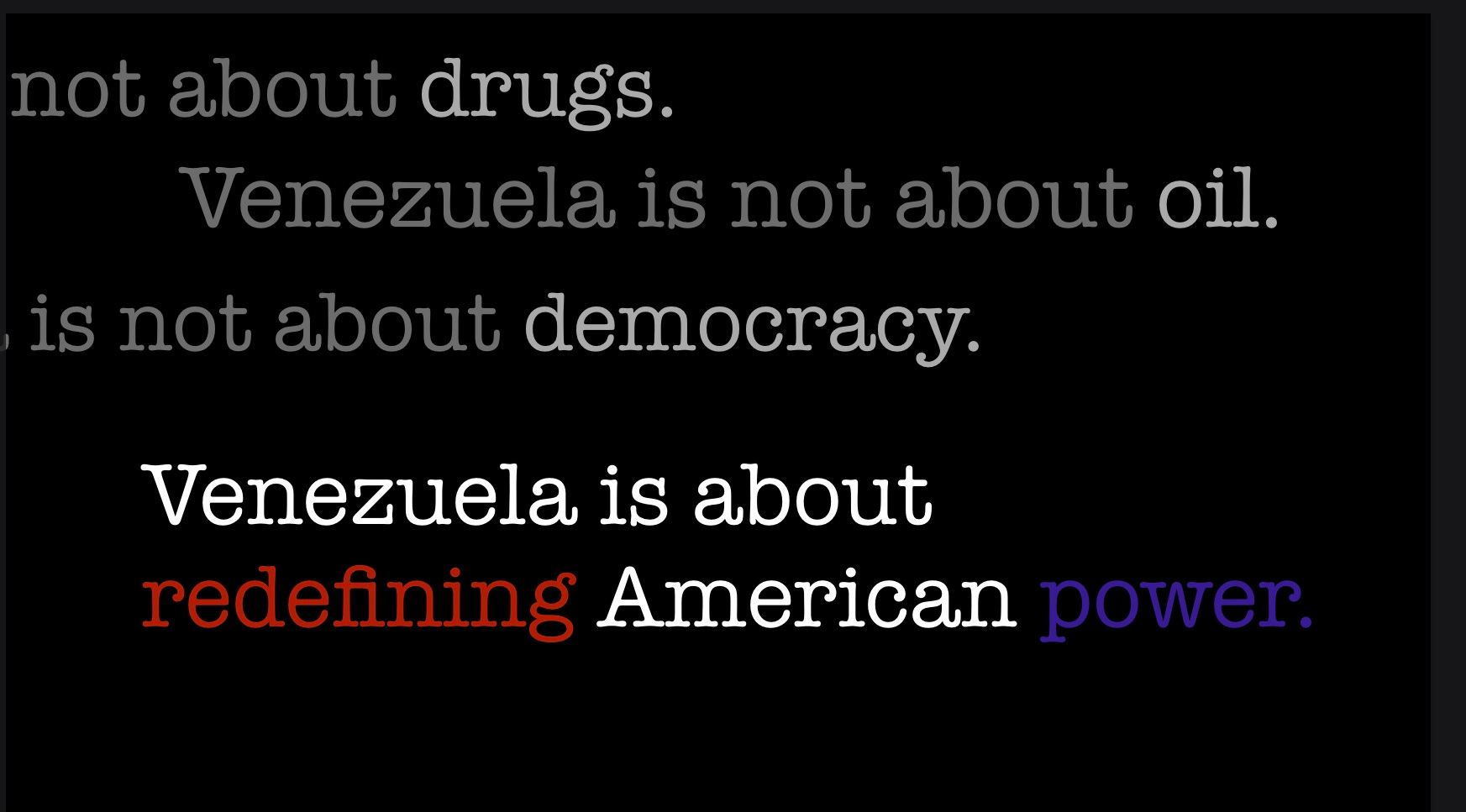
Venezuela is not about drugs. Venezuela is not about oil. Venezuela is not about democracy.
Venezuela is about redefining American power.
This Great Power long-read, which looks at the parallel lines of effort pushing us toward conflict with Venezuela, is split into 7 sections, posted as 2 parts [or subscribers can listen to the audio version here — https://www.greatpower.us/p/the-war-on-venezuela-is-a-war-for-1cc ]:
Introduction — All the president’s spiders
Narrative 1 — “Narco-terrorism”
Narrative 2 — Oil boom in Essequibo
Part 2:
Narrative 3 — Winning a “theater war”
Narrative 4 — “The only free hemisphere”
Narrative 5 — “Homeland” realignment
Conclusion — “Americas first” creates space for cooperation with Russia and China
[continued from part 1]
PART TWO
Narrative 3 — Winning a “theater war”
Before we get to Marco Rubio’s place in the story, we must visit SECDEF Pete Hegseth. This does not require much of a deep dive. It’s a very strange thing to have an American Secretary of Defense strutting around lecturing about wanting the US to be engaged in a massive, theater-wide war so we can break some “restrictive rules” and “win it” with “enhanced lethality” — but needless to say it would take about five seconds and a ball of yarn to convince Pete Hegseth that a war in Venezuela, based around some kind of targeted bombing campaign and special operations activities, is a good idea. Kill them all or don’t let the door hit you on the way out. “We have killers too,” Trump once answered about Putin being a murderer. Seems he finally gets his wish. The ball of yarn is probably optional.
It’s truly unfortunate that Hegseth’s tough guy posturing will scratch the itch of dissatisfaction among a certain kind of military leader frustrated with the lessons of the past 20 years, getting some of them to hitch their wagons to a guy who became defense secretary by arguing war criminals are heroes and who resigned from the National Guard after fellow service members raised concerns about whether his views made him an “insider threat”. It’s clear Hegseth is shopping for brass that agrees with how this administration wants to get things done, and no accident that the two COCOM commanders directly overseeing military action in the Caribbean have been replaced.
There are many, many things to discuss about how the use of American hard power assets overseas has evolved since 9/11. Our undefined end states; our over-reliance on special operations capabilities as an easy button for strategic problem solving — which means the misuse of some of our most potent operators and capabilities on tasks where they are wasted, and the underdevelopment of more conventional assets to accomplish these tasks; our very conception of what war will look like in this modern era, and how our military is recruiting, training, and retaining the expertise we need to fight those wars — there is a lot we need to sharpen given the perilous state of the world and the critical role the United States has played in global security during the last century.
Until recently, we agreed on what the threats were and debated how best to prioritize them, address them, and balance those needs with other priorities, as any democratic nation does. Now we’re veering quite far away from that, denying assessed threats to fit political storytelling, at scale.
As retired Admiral James Stavridis — former SACEUR and SOUTHCOM Commander — recently wrote, the buildup in the Caribbean far surpasses what is needed for the alleged drug interdiction operations and points toward Maduro as the target. But, as retired Lt Gen Mark Hertling — former Commander of US Army Europe — wrote in this analysis, Venezuela is not a “small Latin American country” and the allotted manpower is significantly less than what would be needed. Tackling Venezuela’s complex human, geographical, and political terrain with insufficient resources, he warns, could look closer to Russia’s miscalculation in February 2022 than US success in Panama in 1989 (which conservative commentators have been referencing as a model).
Anyone familiar with Trump’s planning of a special operations invasion of North Korea during his first term — which has been widely referred to in memoirs from and books about his first presidency, plus piecemeal stories like this recent one about a failed SEAL team operation into North Korea — should have questions. Questions about how much planning has been done, questions about what the predicted casualty rate for “limited” operations in Venezuela would be, and questions about whether any of those assessments are impacting decision-making in this administration. Because while Jim Mattis would say no to something where more than half of soldiers sent on a wild mission wouldn’t return — is anyone sure that would be the case with someone who keeps talking about needing to win a ‘major theater war’ — Mr “Lethality” himself?
“One conflict stands out in stark contrast — the Gulf War,” Hegseth said in his TedTalk to the generals. “Why? Well, there’s a number of reasons, but it was a limited mission with overwhelming force and a clear end state.”
We don’t have overwhelming force present, unless it’s a massive bombing campaign. Do we think there an even a clear end state imagined that Hegseth can articulate without a cartoon turtle doing the heavy lifting? I’m not so sure given his overt slavering over tactical prowess only.
Without a clear end state in mind already, every day of this deployment weakens American power and makes the situation worse. Once you label Maduro a cartel boss and put his wanted poster up on the wall of the saloon, you have to go play sheriff. Otherwise no one is ever going to take your great big nuclear-powered aircraft carrier seriously again. Rocks rolling down a hill.
Narrative 4 — “The only free hemisphere”
Or, Marco Rubio seeks salvation among all the devils’ deals
Knowing procurement of hard power would be a breeze, from the oil and drugs and migrants and gangs, Secretary of State/National Security Advisor/National Archivist Marco Rubio saw a new way to press President Trump to care about the liberation of Venezuela — a thing which Senator Rubio had always supported. Rubio has been criticized for seeming to abandon many of his past ideological beliefs to find a position of power within MAGA — that gold-lacquered bamboo chair of discomfort when you are the one destroying American soft power, canceling democracy support programs across Latin America, canceling TPS for Venezuelans, defending the deportation of tens of thousands of people just like your own parents who came to America from Cuba not so very long ago.
Turning the Miller anti-immigrant narrative into his personal salvation is desperate and it is clever. No matter that it makes Nicolas Maduro the singular baddie directing all the dark forces against America in a largely fictional way. It pulls the right threads to make it an easy story to sell to a memetic president.
Maduro is directing these cartels trafficking people, criminals, and drugs into America. If he is removed, we can stop the drugs and the destabilization that causes migration, and the Venezuelan opposition — which the US recognizes as the rightful victor of the last election — can easily step in to control the country, and they can pay for the whole thing with oil. Think of all the oil we’ll be pumping with Maduro gone! It pulls the strings. But there’s also another layer.
The limp, dead-end isolationism of the JD Vance faction of the administration has failed to gain real traction is because it doesn’t tell enough of a story about what you need power for. You can only take over so many Kennedy Centers and Columbia Universities and CBS Newses before owning the libs loses its luster — especially when you are asking Americans to accept wild curbs to basic liberties in exchange for “security.”
You need the evolving story for control, to advance the consolidation of power into the presidency apace. Rubio’s plan to squeeze Maduro won out over Special Envoy Grenell’s plan to make mutually beneficial deals with him because Rubio made it into a better story. Somewhere deep inside, the voice of past Marco Rubio is still rattling around, apparently, believing people want freedom — and believing leaders want greatness, and will take the chance for greatness when it is in front of them.
Rubio wouldn’t be the first one to try to get Trump to bite on greatness and fail. But Rubio is trying to pursue a big story — a huge gamble to shift perceptions of Trump’s legacy and what MAGA is, and to secure his own MAGA future, if it works.
If. The tension this creates in MAGA is obvious, if you listen to the forever podcasts decrying “neocon saboteurs” trying to trick Trump into a new war. But so far Rubio is still in that rickety chair.
His essential counterpart in this the Venezuelan opposition — and in its current iteration, that is Machado.
In 2019, Rubio encouraged Trump to make a speech to the Venezuelan community in Florida. It included this line: “When Venezuela is free, and Cuba is free, and Nicaragua is free, this will become the first free hemisphere in all of human history.”
In October when Machado was awarded the Nobel Peace Price, she said the following: “Once Maduro goes, the Cuban regime will follow, the Nicaraguan regime will follow, and for the first time in history, we will have the Americas free of communism and narco-dictatorships.”
I don’t believe the similarities are accidental. Machado, like Rubio, has become enormously skilled at mirroring MAGA narrative to make it seem they want the same things — so much so that I’m not actually sure where the lines are between what she believes, what she thinks she has to tell Trump to get him to remove Maduro, and what she will actually do if she gets a chance to power. Since being award the Peace Prize, she has seamlessly flattered Trump as Venezuela’s true possible savior. It’s hard to watch without grimacing, but it’s smart strategy given the overt psychology of the president.
Machado has said she will leave Venezuela — where she has stayed in hiding as many of her key deputies have fled abroad — to attend the Nobel ceremony in Oslo on December 10. At that point, she becomes an international fugitive — unless maybe she can hitch a ride home with some friends? Of course, if you sneak out, you can sneak back in. And so can others.
Meanwhile Rubio mostly hides in plain site, echoing MAGA narrative points back, but trying to connect them to something that means anything in the defense of the values of the free world.
He has a clear, structured approach for this. Latin America has been a top priority for him as SecState. On the same early trip to Guyana where he threatened Venezuela not to try military incursions into the territorial waters where the Exxon oil fields are, Rubio visited other nations who signed on to a cooperation agreement with the US to be supportive of US operations in the Caribbean Sea. Those included Argentina, Paraguay, Ecuador, Guyana, and Trinidad & Tobago, which “expressed their willingness to collaborate in joint actions against drug trafficking.” This got zero attention in US media, but was glowingly written about in the national outlets of the partner countries, for whom it is a big story. As described earlier, it is a big story, as it bolsters American engagement in the Americas and points it toward a common binding task.
No one wants to say “regime change” — so it’s Maduro is a criminal, and the necessity of removing him for American security.
This is the case Rubio made to the White House to start the movement towards potential operations against Venezuela. It attempts to bend the arc of MAGA back toward the defense of the free world. I wish him the absolute best of luck with this endeavor.
Only, he isn’t the last turtle in the stack. And Trump still has that thing about Russia…
Narrative 5 — “Homeland” realignment
Or, “Americas first” creates space for cooperation with Russia and China, rather than confrontation.
Just after the first boat strike, there was a leak from the Pentagon about the new draft National Defense Strategy. During the first Trump administration, this document focused on normal things, like the threat from China and Russia, and, in that version, that China should be prioritized over Russia. But this new draft was a distinct departure from the expectation of a continued “China hawk” approach, focusing instead on “the homeland and the Western Hemisphere.” This will also have consequences for the global force posture review — a review of where American military assets are based overseas. A recent Senate hearing reflected great frustration from lawmakers about the opaque process of the Pentagon drafters and whether or not their proposed revisions actually reflects the priorities of the president.
The draft National Defense Strategy has been privately described as “like something Dugin wrote” — a reference to Russian ideologue Aleksandr Dugin, whose ideas about limiting the impact of American power and history are credited with informing Putin’s worldview. Dugin says a lot of things, with a lot of words — but the important point in this instance is achieving the withdrawal of the United States from Europe back to the Americas. Essentially, China gets Asia and Russia gets Europe, everyone can squabble equally for African resources, and the US will be tied down by conflicts in its own hemisphere. I think Dugin mostly imagined this meant inspiring Venezuela or another Russian regional ally to increase hybrid, disruptive actions against the United States — weaponized migration, whatever — leveraging the massive Russian intelligence presence in Mexico City and throughout Latin America. He’s probably getting a good laugh that we’re doing it to ourselves.
I’m not sure how Colby was convinced to sell the contraction of American power back to the Americas only as his big idea, abandoning commitments in Europe and Asia along the way. Maybe it’s just his attempt to eat the other spiders first. But it has deeply unnerved people who have seen what he’s drafting. And it’s not disconnected from the Venezuela show.
It seems he’s observing the rocks rolling down the hill, and harvesting some piece of momentum from each of them.
The obsessive, unnecessary focus on the security of “the homeland” from the first — more American troops needed in American cities and near American shores means less need to come up with excuses to abandon allies.
From the second, the acceptance that, properly structured, the three global great powers — China, Russia, and United States — can find opportunities for mutual profit and cooperation when they each agree to remain in their primary area of interest. When values are downgraded and interests supreme, there’s a piece of the oil deal for everyone, for example, and these deals can keep things in balance. (This is also the view being advanced by the real estate tycoons tasked with negotiating with Russia.)
From the third, the acceptance that rules of the post-WWII free world are dead, and the that our concept of power must be closer to our great power adversaries than our free world allies.
From the fourth, that the actions of those who disagree with you can nonetheless be captured into your efforts to subvert their beliefs — that the ruse of Venezuelan liberation can be the capstone on the decline of American power.
So overall, here in the fifth, that in “Americas first” there is the space for and the necessity of cooperation with our adversaries to complete the transformation of America into this frankensteined creature.
The rocks are all rolling down the hill. But only the slowest one sees where the others are going.
* * * * *
Conclusion — “Americas first” is about creating space to cooperate with our adversaries
Were Maduro to disappear from Venezuela tomorrow — either facing justice as delivered by his own people, falling to a US “decapitation” strike, or fleeing to a middling dacha somewhere outside Moscow where his new neighbors Viktor Yanukovych and Bashar al Assad would invite him to sauna — few would shed tears. Hugo Chavez, Maduro’s revolutionary predecessor, had charisma, ideology, and oil boom times. Maduro has none of these. In the times of cheap oil, Maduro and his family discovered their real skillset: honing the machinery of corruption for control.
Maduro has ruined Venezuelan prosperity. He has offered just about every global bad actor a foothold in Venezuela. He has jailed political opponents, driven them into exile, cracked down on protest and free speech. He has co-opted the judiciary, rigged election after election, rewritten the constitution. Since the Bolivarian Revolution in 1999, more than 20 percent of the country has emigrated, a process that greatly accelerated after Maduro took power in 2013. (Some 10 percent of Venezuelan emigres have ended up in the United States, many legally under temporary protected status, or TPS, which the Trump administration allowed to lapse for Venezuelans on November 7.)
There are few who do not directly make money from Maduro who will miss him when he’s gone. But it’s a long, long way from despising Maduro to inviting an American invasion of Venezuela.
Many of the Americans cheering this onward — and the Venezuelan opposition hoping to find his empty chair — speak about the military buildup as an aspirational pressure campaign that will force Maduro from power. US officials are publicly floating the idea that he could live a nice life on a beach in Turkiye somewhere — at least as long as Erdogan maintains his grip on power — despite the fact that this flies in the face of the idea he is a dangerous cartel boss instead of a corrupt ruler.
Maduro has many sins. Drug trafficking, or profiteering therefrom, is not above the middle of the list. I don’t wish him one extra day in power in Venezuela. But how that removal is achieved matters greatly for the future of Venezuela —and now it matters greatly for the future of the United States.
Lately there are too many think tank-types leaning into the “of course Maduro should be removed” discourse without more than a dismissive “Special Forces can handle it” line about the military realities of his “removal.”
No champion of freedom wants to miss the boat on getting rid of an anti-democratic baddie (maybe boats aren’t the right analogy to use here). But the five box flow chart being presented as a fool proof victory plan — military buildup+max pressure —> targeted strikes on critical security infrastructure+Maduro —> some sort of opposition-led force of hundreds of thousands arises to take control+clean out rest of baddies —> opposition government takes power with no resistance —> oil revenues fund the entire recovery+return of Venezuelans+cut to US of A — is missing a lot of steps, potential actors, and contingencies.
A variety of actors, foreign and domestic, have seen opportunity in the noise and have sought to influence the echoing — and found an American administration rife with targets for influence since everyone around the president is constantly jockeying for position and the opportunity to show they are the most bestest at telling this story of dire American struggle. Some of these foreign actors — for example, the Venezuelan opposition — are doing this with good intentions. Others — for example, the Russians — just hope they can keep subverting American will into de facto eroding American power.
Anything can happen in the next episode of the show. But for now, there’s an alliance framework being built out that includes Trump’s captive cryptobros — Argentina’s Milei, the El Salvador guy with his black site prison, Bolsonaro if he manages to escape from prison — and a wider array of smaller Latin nations eager for broader US engagement. There’s narrative architecture in place to justify the operation against the “bad guys.” There are plenty of reasons Trump can reflexively reference — oil, drugs, crime, migration. And it all fits into the strategic document refocusing on the western hemisphere, in ways beneficial to both China and Russia as America redefines itself as a peer instead of a competitor.
The part that sits least well with me is there are a dozen ways to approach this, and the one they are loudest about is the war on drugs. And that seems to be because it is the war on drugs that connects the military mission on the seas to the need to deploy US forces inside the United States.
All of it is premised on distortions, lies, narrative. The war is not on Venezuela — the war is on Americans.
The Russians couldn’t have written it better. It’s a spy novel I could do without.
— MM
