

There are three problems America tends to have as a nation trying to understand its adversaries — and this has led to the continuous debasement of American power by recent and successive administrations.
First, in the arc of the past 35 years, we don’t identify adversarial powers or threats properly. We are constantly surprised by enemies, or else devote disproportionate attention to imagined enemies that don’t deserve more than a B-rating.
Second, when we do identify an adversarial force, we do a poor job of seeing them clearly and understanding what it means for us. Since 2007, for example, Russia has been crystal clear about what its objectives are vis a vis America specifically and the West more broadly, and we decided to ignore all the words on the paper to believe our own feelings that if we can just incentivize Moscow to cooperate with us, the benefits are obvious. We lived inside a discordant echo chamber where we believed the Russian smoke and mirrors about their strength, but disbelieved their willingness to use force to achieve political and strategic objectives. We aren’t the ones paying the biggest blood price for this failure. But it’s absolutely naive to believe it hasn’t cost American lives on at least four continents.
Third, we perpetually prefer to forget that our greatest weapon and our mightiest shield is the single most significant accomplishment of our nation (and of what we think of as western civilization): international human rights law.
As a nation, we are most pathetic internally and in the world when we forget that our revolutionary founding documents embodied ideas about human equality and human freedom that, in various forms, have spread out into the world not just as aspirational benchmarks but as rights to be defended and upheld. This is an absolute miracle in the long human story of oppression.
The concept of human rights law is one most Americans take for granted and would struggle to explain and define, so I’ll offer two passages which rattle around in my head about what it means, and a recent reflection on why we should care.
The first is from Sebastian Junger, a generationally important American writer of war, of belonging, of freedom. This is from his monograph, Freedom:
“It was not until the sweeping human rights laws of the twentieth century that freedom stopped being a question of fighting off one’s enemies. International treaties established mechanisms for imposing sanctions or even taking military action against regimes that committed gross human rights violations, and that made freedom a concern of virtually the entire world. Enshrining human rights as the apex of international law is one of the greatest achievements of Western society—perhaps greater than landing on the moon or decoding the human genome—but depends entirely on maintaining a delicate balance between national sovereignty and collective action. All it takes to destroy that balance is for one powerful nation—Hitler’s Germany, for example—to decide they’re better off doing whatever they want and suffering the consequences than abiding by the treaties. In the case of Germany, it almost worked.”
I probably reread this at least once a week, in looking for better words to describe what we are letting slip away without lament — better words to describe the warning we have missed. That freedom stopped being a question of fighting off one’s enemies — that freedom stopped being a small place defined by boundaries, but became the limitless physical and mental spaces that have allowed human ingenuity to flourish.
There can be no better description of modern freedom, why we must cherish it, and why it necessitates collective agreements and specifically collective defense. There can be no better understanding of why wars of aggression fail to produce durable solutions than in knowing powerful nations diminish freedom for themselves and others when they decide might makes right. Why? Because when the high of the violence wears thin, you are in a smaller, harder space, surrounded by enemies. Existence becomes the permanent struggle, choices limited, walls to keep us in as well as others out. It’s an illusion of freedom only.
The second passage is from the opening statement of the United States at the Nuremberg trials, delivered by Supreme Court Justice Robert Jackson, who served as a US prosecutor of Nazi war criminals.
“Wars are started only on the theory and in the confidence that they can be won. Personal punishment, to be suffered only in the event the war is lost, will probably not be a sufficient deterrent to prevent a war where the war-makers feel the chances of defeat to be negligible. But the ultimate step in avoiding periodic wars, which are inevitable in a system of international lawlessness, is to make statesmen responsible to law. And let me make clear that while this law is first applied against German aggressors, the law includes, and if it is to serve a useful purpose it must condemn aggression by any other nations, including those which sit here now in judgment. We are able to do away with domestic tyranny and violence and aggression by those in power against the rights of their own people only when we make all men answerable to the law. This trial represents mankind’s desperate effort to apply the discipline of the law to statesmen who have used their powers of state to attack the foundations of the world’s peace and to commit aggressions against the rights of their neighbors.”
Until and unless we defend the rights we enjoy as the rights of our neighbors, we are all at risk of having our liberties taken from us. This truth that freedoms at home and abroad are connected, and that when the American shield is more expansive abroad, we feel greater freedom and possibility at home — I don’t think many Americans can quite define this, but we feel the truth of it in the times when we are living it. As a nation, we are underserved by American news — which does not speak of the world — and alternatively told we do not need to care about much by the current generation of politicians who think reading polls is governing, and whom we reward with re-election for never challenging us on anything.
But we feel this echo. The smallness and contraction of the current America chafes.
We don’t elect presidents for foreign policy but we abandon them for foreign failures.
Our sense of ourselves has always been bigger than a nationstate or our geography. It doesn’t make us perfect global actors. But it gives us a magnetic north.
And that’s the third and final thing I want to reference — as I think about freedom, and the next Nuremberg, and the war in Ukraine. The righteous war Ukraine fights to defend the world we helped build, which we have left them to carry the burden of while we pursue lesser conquests.
Living in the black-and-white days of Russia’s full-scale invasion of Ukraine — nearing 1500 days under daily Russian bombardment of Ukrainian civilians, cities, and cultural heritage; 1500 days building a file of evidence of Russia’s attempted genocide of the Ukrainian people; 1500 days of relentless decision-making and forward action without alternative for Ukrainians military and civilians alike — Ukrainians have perfected a unique gift for cutting through Western uncertainty with praise meant to bolster our own spiritual resources — our will to fight the war we face.
At a security conference this past month in Vilnius, Major Yevhen Karas, commander of a Ukrainian unmanned systems forces regiment, offered this quiet reminder of what is at stake with his summary remarks for his panel.
“As a military and as the civilian people of Ukraine, we are very proud to be a part of Europe, and proud to have your help in helping to save our lives. We understand that we are protecting Europe because the next victim could be any other country neighboring Russia... But remember that the main weapon — in a drone conference, and talking about AI technologies, modern technologies — your main weapon is your moral level, your ideology, your readiness to protect your country, your life.”
Our beliefs are what set us apart from Russia and the way Russia fights its wars, he reminded — they are both what we fight with, and what we fight for.
It is an important reminder. Because we just need to constantly remind ourselves that the source of America’s greatest, most unstoppable, most asymmetric power is its defense of the idea of human freedom.
* * * * *
In the last few months of 2025 and the first few months of 2026, Americans and our allies have been buried by an avalanche of words from the US administration, a discordant amalgam of revisionist history, abandonment of ideals, and the abdication of power and responsibility — all hidden behind the language of aggression.
These wars of incidental liberation speak poorly of an American president and cabinet who are afraid to articulate their theory of power to the American people, and they speak poorly of the American people who cheer them for the two-bit explanations offered.
While there are plenty of times in history when our language of liberation to justify foreign intervention fell short of its goals or was really just reflexive geopolitics, the embrace of the cynicism — “At least Trump is honest that it’s all bullshit and we never cared at all” — is a reflection of our eroding belief in the founding ideas of our republic. It is a reflection of the exceptionally poor leadership that currently fills the ranks of public and private posts on America, in elected and appointed office, in institutions of education and civic life, in posts of moral, financial, corporate, and scientific authority. No one can be bothered to convince anyone of anything. Polls are designed to capture the laziest and most detached definition of citizen responsibility, and our leaders rely on them to absolve themselves of doing anything hard. The metrics by which we judge our lives are wrong, and the money is rewarded to those who stand for nothing and are the least willing to give any consideration to the people around them.
The generosity of spirit that once defined our nation — generosity of shared freedom, generosity of opportunity, generosity of possibility, generosity of common aspiration — is tangibly absent now, a dream that was so desperate and sweet that you did not want to wake from it and reach out your sleepy fingers to brush the wisps as they dispel.
Wars of incidental liberation — or not. Mostly not.
The quick deal with the deputy dictator of Venezuela left no possibility for illusions outside of the flex. The deal was done before the strike. As the president said himself this past week: “Venezuela was so incredible because we did the attack and we kept the government totally in tact.” No illusions of liberation, then. And in that instance, the leader of the supposed opposition forces was removed before the action by American security contractors — sent out to receive her Nobel peace prize in what can now be understood as a deliberate attempt to ensure the possibility of that movement was cutoff and discredited. The American choice was the deputy dictator — please deposit our share of the oil revenue in this bank account in Qatar. Good luck to you, freedom-aspiring people of Venezuela — btw we revoked your legal status to live in the US, pack those bags and make plans to self-deport.
The US is not the sole actor in current operations in the Middle East — but amidst the shotgunned explanations of why and what now is again a clear preference for finding a strongman to stick in the chair. Again, there has been some effort to identify a democratic alternative to Iran’s repressive regime — nods to the street protests and the tremendous efforts of Iranian women to stand up to oppression; nods to the “baby Shah” and the long fanfic of his potential to return and reset Iran; calls to some amorphous “people of Iran” to rise up while a generally bombing campaign is underway and oil sludge rains down on Tehran. But this has very much been presented as — and if you don’t succeed in seizing power on your own, you missed your only chance, oh well. This intentionally ignores the profound structural differences with how power works in a nation like Iran versus a nation like Venezuela. It seems designed to discredit those forces — again. It again ignores that a democratic Iran would be a boon for regional stability and for American security — if not necessarily beloved by the Gulf monarchies that are deeply involved in whatever is going on.
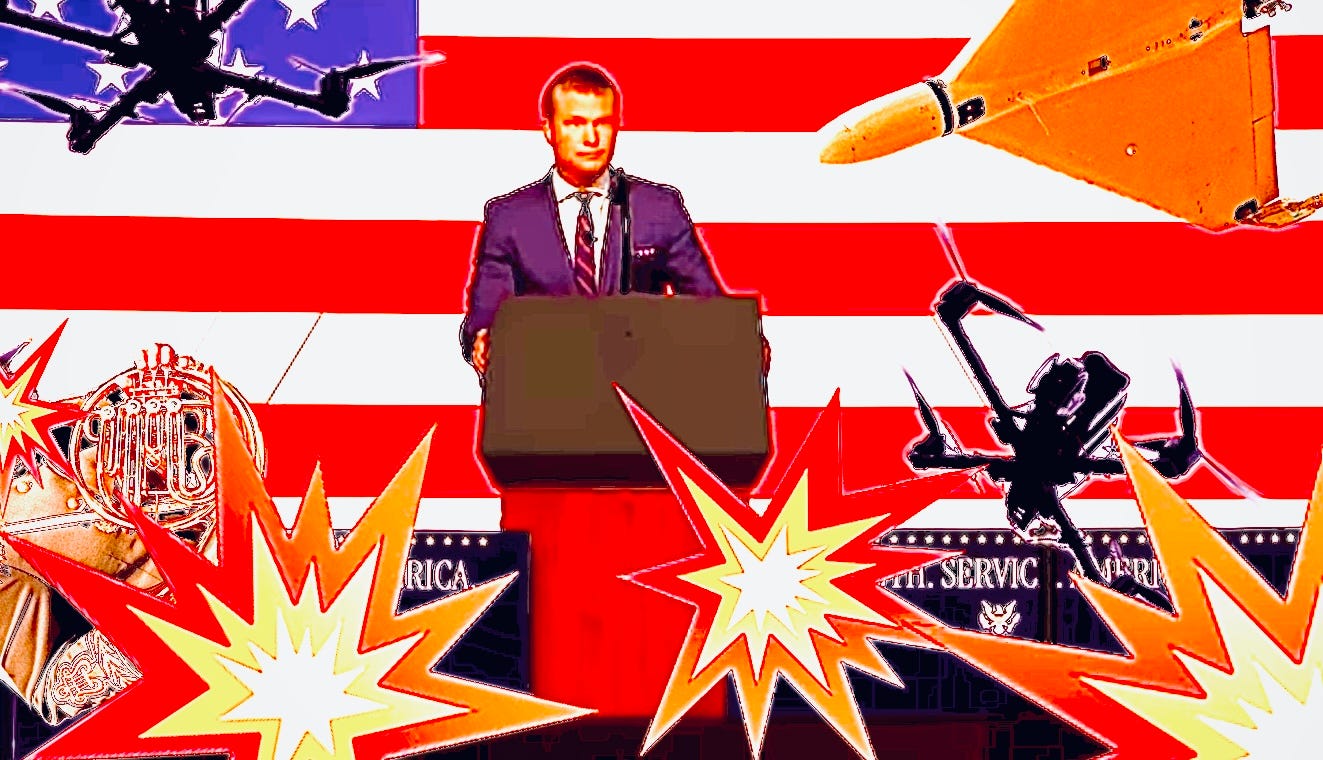
Listening to the fervid press conferences of the secretary of defense and reading the rage-bait social media posts of the Commander in Chief, the only certainty is the lust for selling the necessity of absolute destruction. SECDEF pushes the new ideal of America as a bully, a “Christian war” of punching those who are weaker than us because we can. They believe they are the men who will do the violence others won’t as a necessity of the world they want to live in — where freedom is for those who do violence, and where tearing things down is the point. They are deep in the high of the game play and have no idea what day it is or whether it’s day or night outside.
Blowing advanced munition stockpiles might leave us in a twist? Who cares, just declare we have infinity ordnance. Americans might die? Of course they will. Russia is giving Iran intelligence to kill American forces? So what, they did the same with the Taliban and this president didn’t care about that either.
So — or not, it seems.
But the adrenalin is flowing. Don’t even finish the sentence on Iran. Cuba next. Venezuela who?
What’s meant to sound big stick is actually just small dick.
They slaver and heave over pronouncements of maiming and gore and destruction. To anyone who understands that great power is not defined by destructive kinetic excellence but by what we build with our moral weapons, the bloodlust and crusader-speak is a pathetic mimicry of what we might actually achieve by directing our operational might toward the necessary fields of battle.
Venezuela, Iran, Cuba — odious regimes close to the nations that call America enemy. But as I wrote in advance of our operations in Venezuela, these operations are counterintuitively designed to create space for cohabitation and cooperation with our adversaries — Russia and China — rather than confrontation. It’s messy on the page, but the questions of what Russia and China are learning from our actions are becoming more clear.
Oil sanctions against Russia are weakened to ease the price crisis of the Iran bombing. Less American weapons will be available for our allies in Europe and Asia who have paid for them — and certainly less will be available for Ukraine. Russia uses this moment to launch what is likely a new offensive in Ukraine. Ukraine gritted through a cold winter of mass Russian bombing and little power and heat to arrive in the spring, where they are expected to give the US and Gulf nations the ability to defend themselves against Iranian attack drones. China pays for the Russian war. The three global powers are on a collaborative bender of tearing it all down, and Europe isn’t sure yet if it wants to be the fourth real power in this spectrum.
We blew up this and that and decapitated some head of a regime that is a regenerative hydra — so what?
Accomplishments are defined by strategic victory — which cannot be achieved when there is no strategy beyond the volume of bombing, precise or otherwise. The living case study of this is the inability of Russian forces to achieve any strategic objectives against a morally-superior peer Ukrainian force.
It’s a debasement of American power, to render its tally sheet in blood.
But the blood sport ring is even now being built on the White House lawn to commemorate our independence — built just on the spot where the president turned an insurrectionist mob toward our capitol. It never happened, we are now told, but is a tangible reminder that we are not the nation we think we are. A culture of violence takes root in our nation, championed from the top, capturing the elements of state violence, standing singly in a space absent any leadership at all.
Boys playing games long after they were supposed to be tucked up in bed, leering at the naughty pin-up girls on the back of the door. They explain American sacrifice is for the blood of the enemy — and not for any greater purpose at all. After decades of whining about how we would win everything if we would abandon our rules of engagement and “jihad the jihadis,” the jingoists have convinced themselves that an orientation defined only by violence and emulating the tactics of the enemy is righteousness.
It is not. It is the pathway to American defeat — where America accomplishes the goal of our enemies by erasing itself as a threat to the authoritarian notion that human freedom should not exist.
How do you like the performance? the president asks. Official communiques splice war footage with video game reel. Let’s sink a boat with a torpedo — because. A dangerous Iranian boat carrying the Iranian military band. Please like or follow this channel so we can keep producing content.
The whole way we train soldiers involves a process of breaking them down and building them back up as individuals in a team psychologically able to bear the consequences of doing things — killing, burning, bombing — that are illegal and wrong outside of the context of war. We give them structures of orders and carefully defined frameworks of rules as part of that education, to insulate them from carrying the full weight of following orders and delivering “tactical and operational excellence.” We do this because our soldiers are not “cannon meat” like Russian conscripts, but are men and women who are regular citizens who need to be able to move between the life of a law-abiding citizen and the life of an active duty fighter as seamlessly as possible. The violence stays in a compartment. It is an unspoken tool that you do not bring home.
When the secretary of defense extols that violence as the higher purpose, those barriers come down. The violence is the soldier and the soldier comes home. The rules of engagement that are meant to ensure our own troops are protected if wounded or captured evaporate when we do not observe them for the enemy. When the point is the violence and not justice — not freedom — our concept of citizen-soldier heroes is erased. We don’t talk about their sacrifice but their kills. And then who the fuck are we really. We have killers too, this president once famously said of our military. This is what he wants them to be. Not all those other things we thank for their service.
* * * * *
Americans have forgotten that our defense of human freedom as a non-finite resource is the greatest thing we have — our sword, our shield, our beacon on the hill, our magnetic north, our moral weapon, our spiritual resource.
Without this we are nothing but what Putin wants us to be — an anomaly in the long arc of human history defined by human oppression under strongman rule.
We walk with swagger when we know we are righteous. We are rubbish when we lose our way on the real meaning and purpose of American greatness — which is inherently in the defense of the freedom of others, and in so doing ensuring the longevity and founding genius of our republic for ourselves.
Decisive action is necessary in the face of lawlessness and aggression — to return to the system of order where freedom is more than the ability to fight off enemies.
There will always be more enemies until we invest in building a world where freedom is about more than fighting them off. We understood this after WWII, when we won the war on the battlefield, and won the peace with tribunals and the Marshall plan. Freedom is changing the system so the enemy’s theory of victory fails. It is assuredly not in embracing the enemy’s rules of war and conducting ourselves as the bringers of death.
— MM
What a fantastic essay, Molly. I absolutely love the way you sling words, it's unstoppable and mesmerizing. And your points - not to mention your ideals - are desperately needed. I do think the whole thing is about to come down on their heads; its a political Ponzi scheme that will eventually run out of new investors to pay the old ones. But right now the cruelty and destruction are just incredibly upsetting.